 Back to selected work
Define
Clarify the integration’s scope, the meaning of its fields, and the context needed to interpret the data.
Backend integration, product development, and AI workflows. Each case keeps my contribution and the current state visible.
At Brame Brands, I help turn data from separate business systems into a shared foundation for reporting, operations, and AI applications. My work spans the definition, development, implementation, support, and maintenance of Brame Data Extraction, the platform used to bring that data into the central data warehouse (CDW).
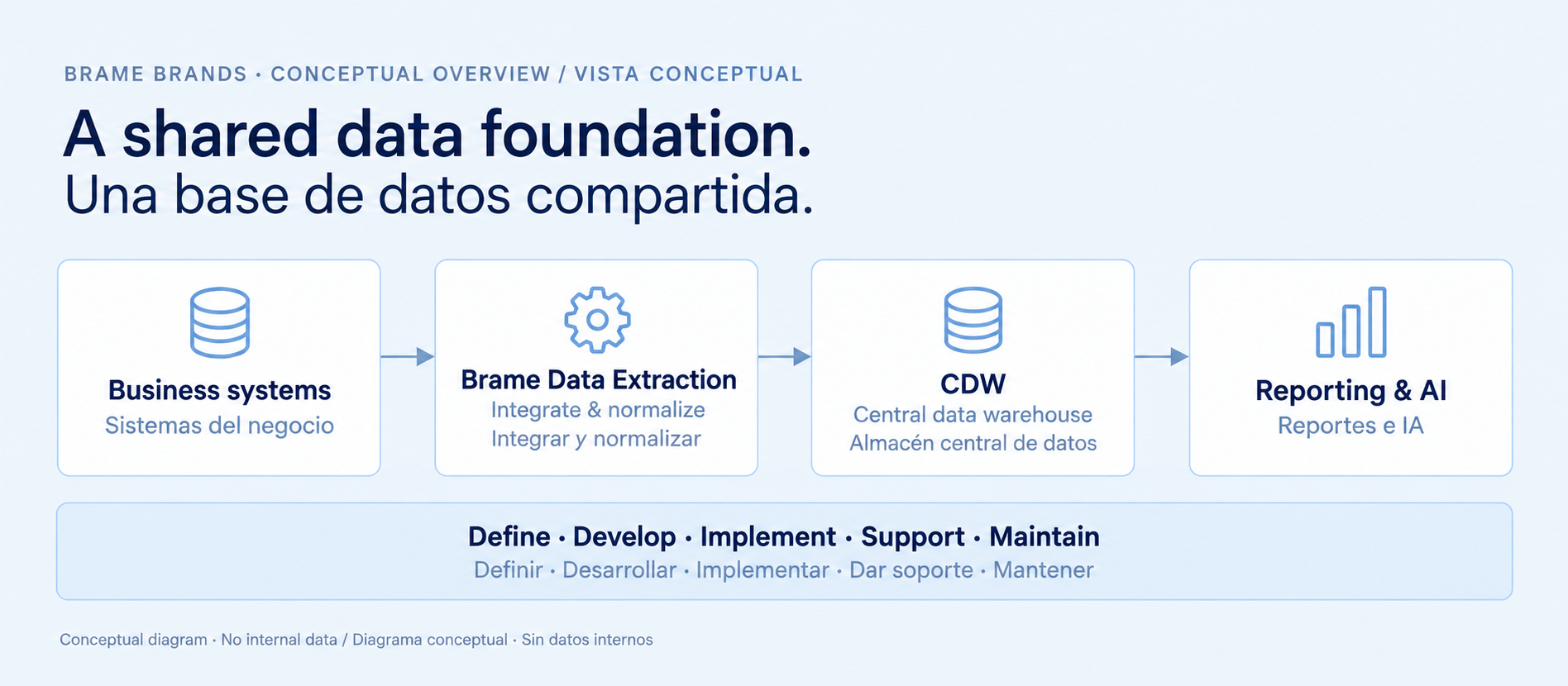
Consolidating data takes more than moving records. Each source has its own access method, format, update cycle, and business context. The team needs to understand what arrived, how it should be interpreted, and what still requires investigation before that data supports reports or applications.
Clarify the integration’s scope, the meaning of its fields, and the context needed to interpret the data.
Build and evolve the backend workflows that obtain, normalize, and persist data from different sources.
Prepare changes for delivery, document how they are validated, and connect implementation with its operating requirements.
Investigate incomplete runs and data gaps, and recover data where the source and integration contract allow it.
Adapt integrations as sources change, improve operational checks, and keep procedures understandable for the team.
Data needs an explicit context. I work with source definitions and integration contracts that preserve the business date, location, and scope needed to interpret a result.
Validation belongs to the integration’s contract. A documented workflow checks structure, rows, and totals before confirming a load for a particular location and date. That provides a concrete example of validating what arrived without claiming that every dataset has the same guarantees.
Operation is part of engineering. Monitoring expected loads helps the team notice a job that never ran, as well as one that reported a failure. Presence checks help identify gaps; they do not, by themselves, certify the accuracy of the values.
The evidence includes implemented integration workflows, data contracts, recovery procedures, operational checks, and documented delivery work. Brame Data Extraction is in operation, with development and maintenance continuing as sources and business needs evolve. My contribution forms part of the engineering team’s work.
 Una Mano
Una Mano is a home-services product being piloted in Managua, starting with plumbing and electrical services. As Co-Founder & CTO, I lead application development, AI integration, and technical preparation for the pilot, connecting product decisions with how the software behaves.
A useful product needs more than a way to find a technician. Clients need to understand what a request means and when a visit is confirmed. The team needs a way to onboard technicians, review their evidence, and control which services become available. Those steps have to work together without losing the history behind a decision.
My work connects the client and technician experiences, backend workflows, and administration tools. I translate product requirements into application behavior and validation criteria: who can take an action, what information it changes, and what the team needs to check before accepting a release.
I lead the technical preparation of this work with the team. Technician onboarding, category review, and pilot acceptance also depend on the people who operate and use the product.

A request starts an evaluation visit. The client chooses a technician and proposes a time; the technician’s acceptance confirms the visit. Scope and price are agreed before work begins. This gives the interface and backend a clear meaning for each step.
I confirmed that an approval should belong to a category, scope, and submitted version. Corrections preserve earlier evidence, and the last approved offer remains subject to its eligibility rules while changes are reviewed. Human approval and publication in the app are separate steps.
AI helps gather and organize reference testimony for a human reviewer. It does not approve a technician. I lead the technical direction of the ElevenLabs integration; the separate AI case explains the evidence flow and its controlled validation.
Documented implementation and checks cover service requests, technician submissions and corrections, version history, category decisions, and permissions. These show how product rules are carried into application and backend behavior; they are technical evidence, rather than measures of pilot adoption.
Una Mano remains in its pilot stage. Complete hosted onboarding and acceptance with the team and technicians are still pending. Payment options for Nicaragua remain under evaluation.
A controlled ElevenLabs team call reached the correct fictional record, and the reviewer view was published. Contact was then returned to simulation mode; real reference use still requires preparation. This milestone does not complete the product pilot.
Learn about the pilot

A reference is more useful when a reviewer can distinguish direct experience from hearsay and inspect the words behind a structured account.
As part of my CTO work at Una Mano, I lead the technical direction for integrating a Spanish-language ElevenLabs agent into this workflow. The agent gathers testimony; the backend preserves transcripts, supporting excerpts, gaps, and contradictions. Signed events, record correlation, and duplicate handling protect the evidence flow. A human reviewer makes the category decision.
Evidence and status: Fictional scenarios and text simulations were followed by one controlled team call delivered to the correct fictional record. The reviewer view was published. The call’s testimony remained inconclusive and did not approve a technician; contact returned to simulation mode. Real reference use remains pending. The portfolio demo is a separate fictional text reconstruction.
Explore the simulation

